The grove
The grove
An olive grove is a working landscape and a living ecosystem. Explore how soil, water, vegetation and wildlife shape grove health and sustainability.
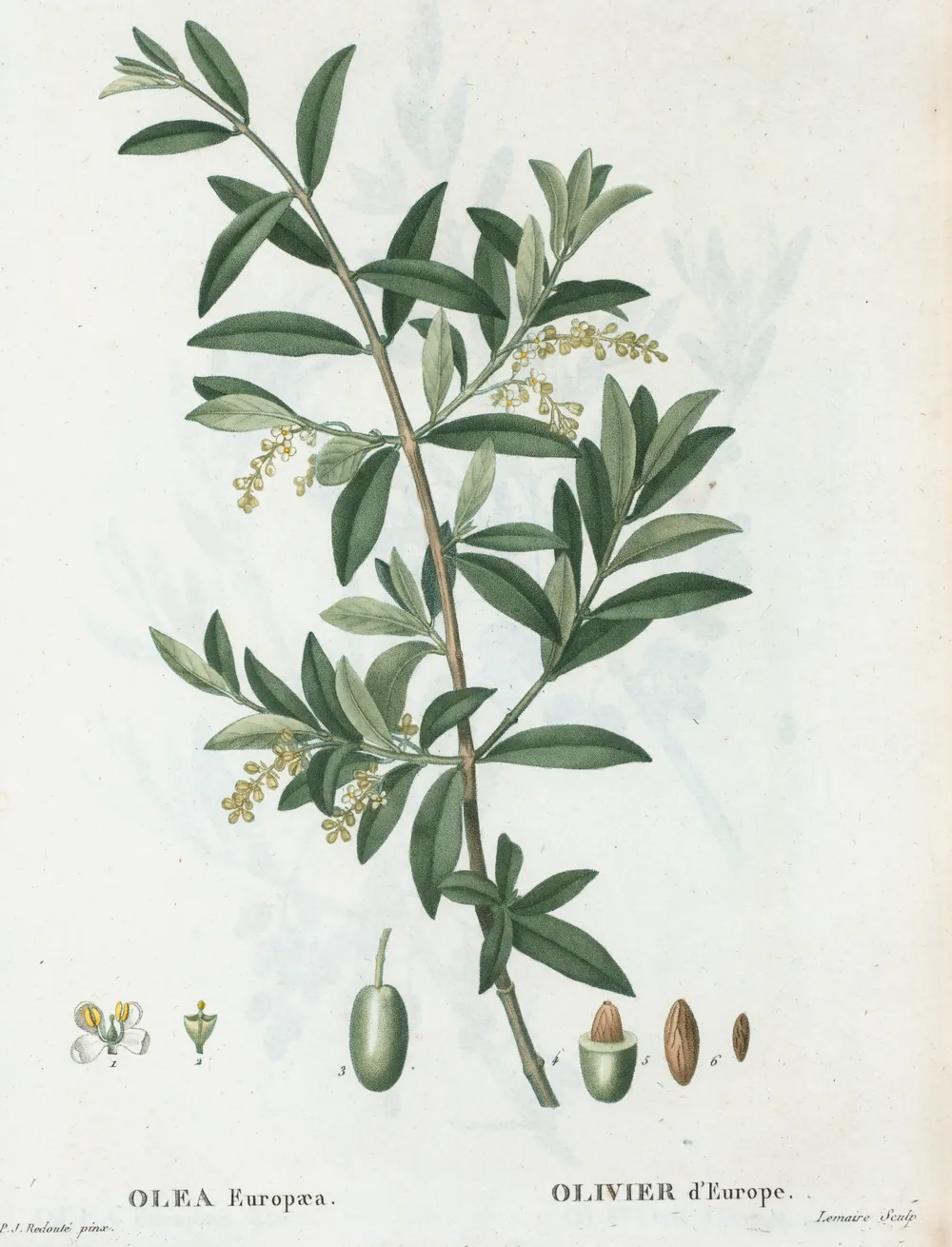
Meet the trees and cultivars at Olival da Azenha.
Carbon, oxygen and the sustainability of a grove · Fungi and mushrooms associated with olive trees · Insects and other parasites · Olive tree diseases
Carbon, oxygen and the sustainability of a grove
An olive and a new branch get their carbon from the same place: carbon dioxide (CO₂) in the air. What differs is how long that carbon stays out of the atmosphere. Much of the carbon in olive oil returns to the air after we eat it; carbon in the wood can stay in the tree for decades.
How much carbon stays in a grove?
An old trunk holds carbon accumulated over many harvests. Keeping that store intact is not the same as removing that much CO₂ again each year. To estimate annual removal, we need to track changes over time in the carbon held in trunks, branches, roots and soil. Fallen leaves and prunings can add organic matter to the soil, but some decomposes and returns CO₂ to the air.
In a study of six olive groves in Portugal’s Alentejo region, researchers estimated that five gained carbon in their trees and soil combined. That gain alone does not establish climate neutrality: emissions from diesel, energy for irrigation and fertiliser also count. An individual grove’s balance requires repeated measurements and records of its own operations; another grove’s removal rate cannot be assumed to apply.
Study: Carbon storage and emissions in six Alentejo olive groves.
Where does the oxygen come from?
In sunlight, leaves use water and CO₂ to make sugars. The oxygen (O₂) they release comes from the water, not from the CO₂. The tree also respires, day and night: it uses O₂ and releases CO₂ to get energy from sugars. Organisms that decompose fallen leaves in the presence of oxygen do the same. The annual balance is the oxygen produced minus all the oxygen consumed within the grove. Oxygen release is not a second climate credit on top of carbon storage.
Further reading: OpenStax — how photosynthesis releases oxygen from water.
What grows between the trees matters too
In winter, ground cover softens the impact of rain and helps hold soil in place. If it keeps growing as the soil dries in spring, it can compete with the trees for water. In an eight-year trial in a rainfed olive grove, plots where naturally growing vegetation was mown in spring had, on average, 28 more plant species than tilled plots. The researchers found no loss of olive yield in that trial.
When to mow depends on rainfall and the water left in the soil. In an irrigated grove, the source of the water and the energy used to pump it matter too. A favourable carbon balance does not, by itself, make up for topsoil loss, pressure on a water supply or the loss of wildlife habitat.
Studies: Ground vegetation, soil water and yield in a rainfed olive grove · Field trial of erosion control in an olive grove in north-eastern Portugal (PDF).
Fungi and mushrooms associated with olive trees
A fungus that helps an olive root may never produce a visible mushroom. In an arbuscular mycorrhiza, fungal threads reach phosphorus in the soil beyond the root surface. Inside the root they form branching structures where nutrients are exchanged: the olive receives minerals and supplies the fungus with carbon it fixed by photosynthesis. A mushroom beside the trunk, on the other hand, may be growing from buried wood without exchanging anything with the living tree.
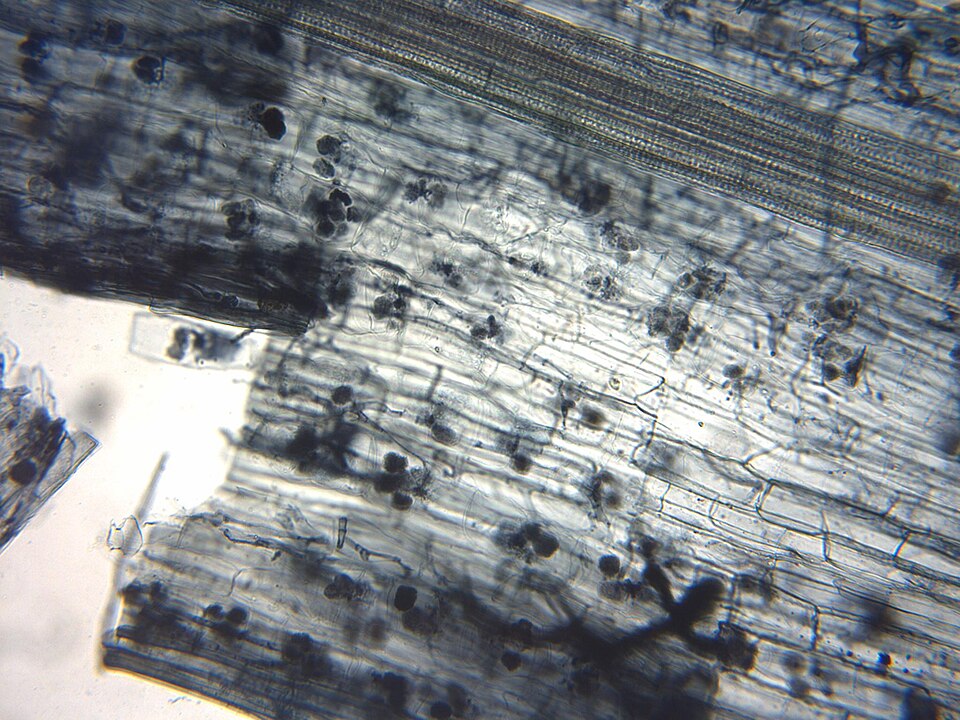

These six examples come from studies and field guides. The photographs illustrate species or habitats; they are not a field survey. What a fungus does to a tree and whether it is poisonous to someone who eats it are separate questions.
- Rhizophagus irregularis — root partner. In trials with young olive trees, it formed branching structures called arbuscules inside the roots and helped the plants grow. For people: it does not produce a cap mushroom to pick; the trials did not assess food safety. Olive-tree study.
- Funneliformis mosseae — root partner. Older studies call it Glomus mosseae. In young olives this partnership can improve root and shoot growth; the result depends on the cultivar and conditions. For people: it does not form a cap mushroom either. A benefit to the tree is not evidence that the fungus is edible. Review of olive mycorrhizas.
- Aureobasidium pullulans — leaf inhabitant. Researchers found this microscopic fungus inside symptom-free olive leaves, making it an endophyte. In a trial on olive fruit, one strain reduced the severity of anthracnose, a fruit disease. That does not mean it protects every tree. For people: it is not a food mushroom; the study tested fruit disease, not the safety of eating the fungus. Olive endophyte and anthracnose study.
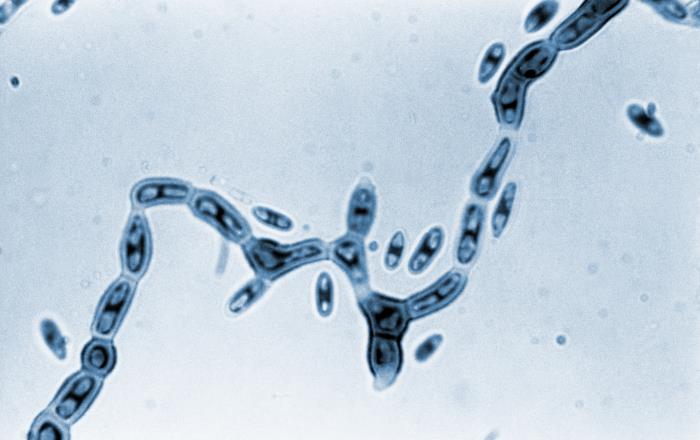
Photomicrograph at 970×. Image: CDC / Lucille K. Georg, 1961, CDC PHIL 25598 · public domain; CDC credit information. - Omphalotus olearius — jack-o’-lantern mushroom. It feeds on decaying wood and can fruit at the base of an olive trunk or from buried roots. It is not a mycorrhizal partner. For people: poisonous. It can cause severe vomiting and diarrhoea and has been mistaken for edible chanterelles. Portuguese conservation institute field guide (PDF).
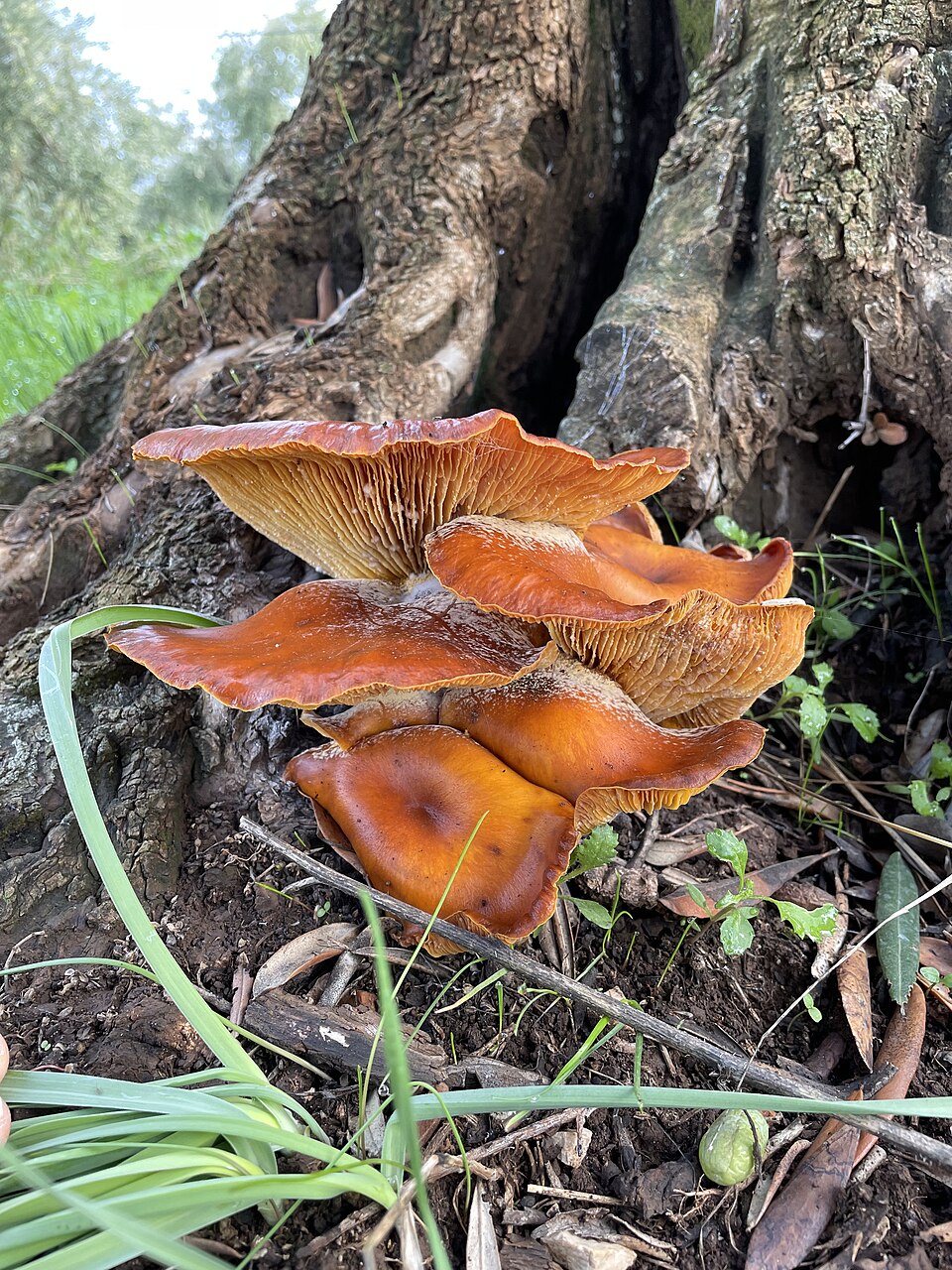
Illustrative species photo, not an identification guide. Photo: Adriano De Astis / Wikimedia Commons · resized for this page · CC BY 4.0. - Armillaria mellea — honey fungus. It can rot the roots of living olive trees and persist on dead roots. Unlike a mycorrhizal partner, it harms the tree. For people: cases of gastrointestinal poisoning are documented, including after raw consumption. Do not treat it as harmless. Olive root rot · Milan Poison Control Centre report.
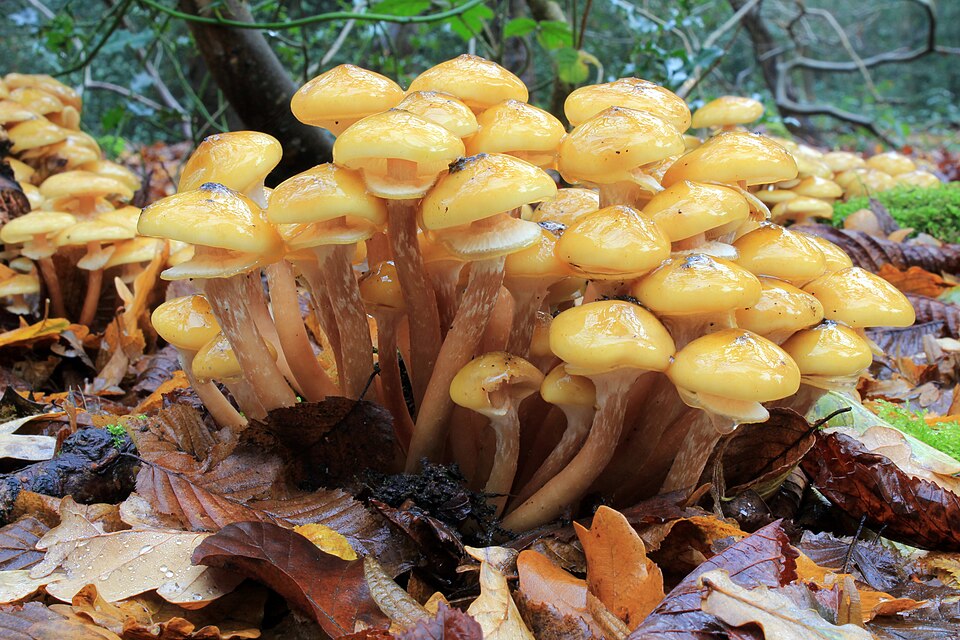
Illustrative species photo, not a survey record. Photo: Stu's Images / Wikimedia Commons · resized for this page · CC BY-SA 3.0. - Pleurotus ostreatus — oyster mushroom. In a cultivation study this decomposer produced mushrooms on material containing olive prunings. It used the cut wood; this was not a partnership with living roots. For people: this species is cultivated for food, but that does not make wild mushrooms found in an olive grove safe to eat. Olive-pruning study.
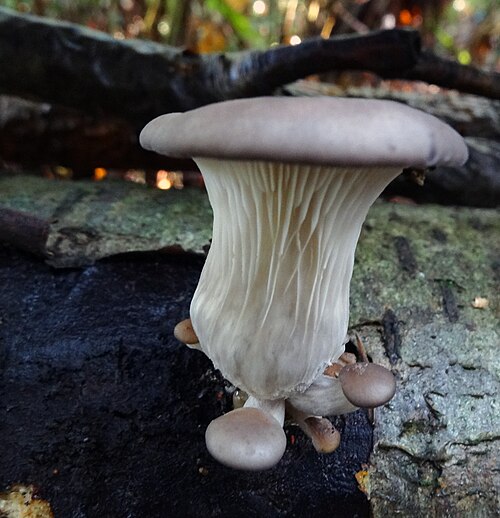
The image shows the species but does not document growth on olive wood. Photo: AJC1 / Wikimedia Commons · resized for this page · CC BY-SA 2.0.


Safety: do not eat wild mushrooms found growing with olive trees. Neither the tree nor a photograph can confirm a mushroom's identity or food safety; some species are poisonous, and growing beside an olive tree does not make a mushroom edible. In Portugal, if someone has eaten an unknown mushroom, call the poison information centre (CIAV) immediately on 800 250 250; do not wait for symptoms.
Insects and other parasites of olive trees
Some insects feed on olive trees and can harm the crop; others are natural enemies that attack those pests. The examples below are documented in Mediterranean olive-growing areas. The photographs are illustrative, not records of a local survey. Finding an insect does not, by itself, mean there is a damaging infestation.
- Bactrocera oleae — olive fruit fly. Its larvae develop inside olives and feed on the flesh. Infestation can cause fruit drop and rot and reduce oil quality. UC IPM integrated pest management guide.
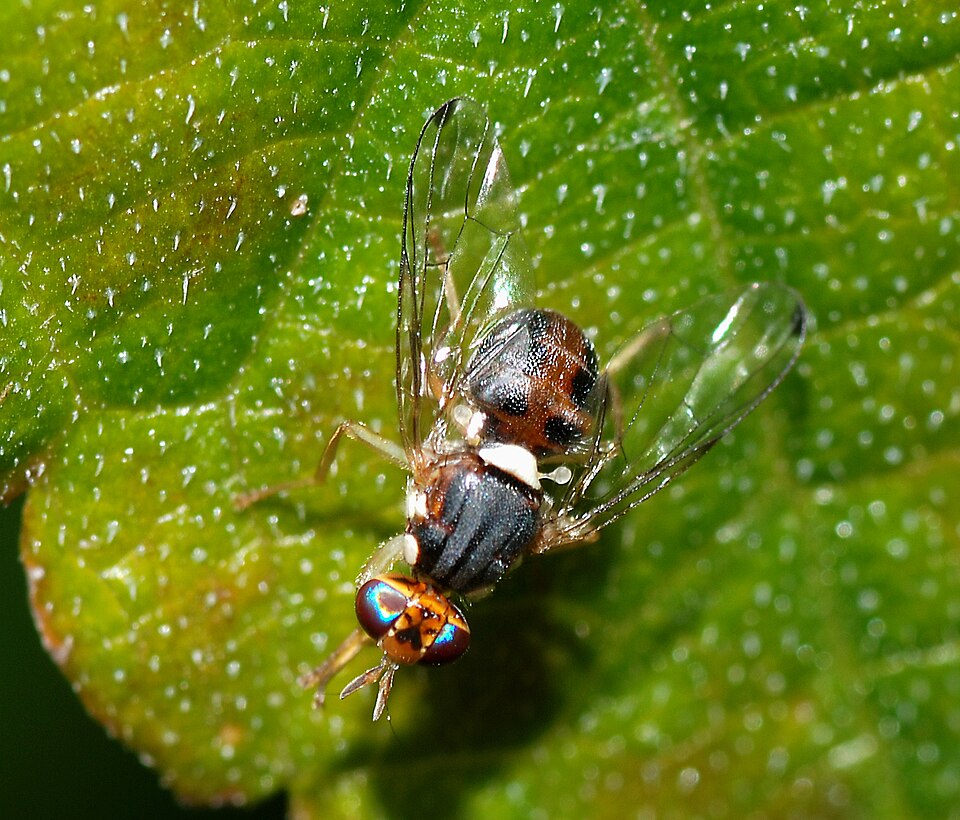
Adult olive fruit fly. Photo: Alvesgaspar / Wikimedia Commons · resized for this page · CC BY-SA 3.0. - Prays oleae — olive moth. Its three yearly generations attack flowers, fruit and leaves, respectively. Larvae feeding on flowers and olives can reduce the harvest; damage varies with the generation and year. INRAE species guide (French).
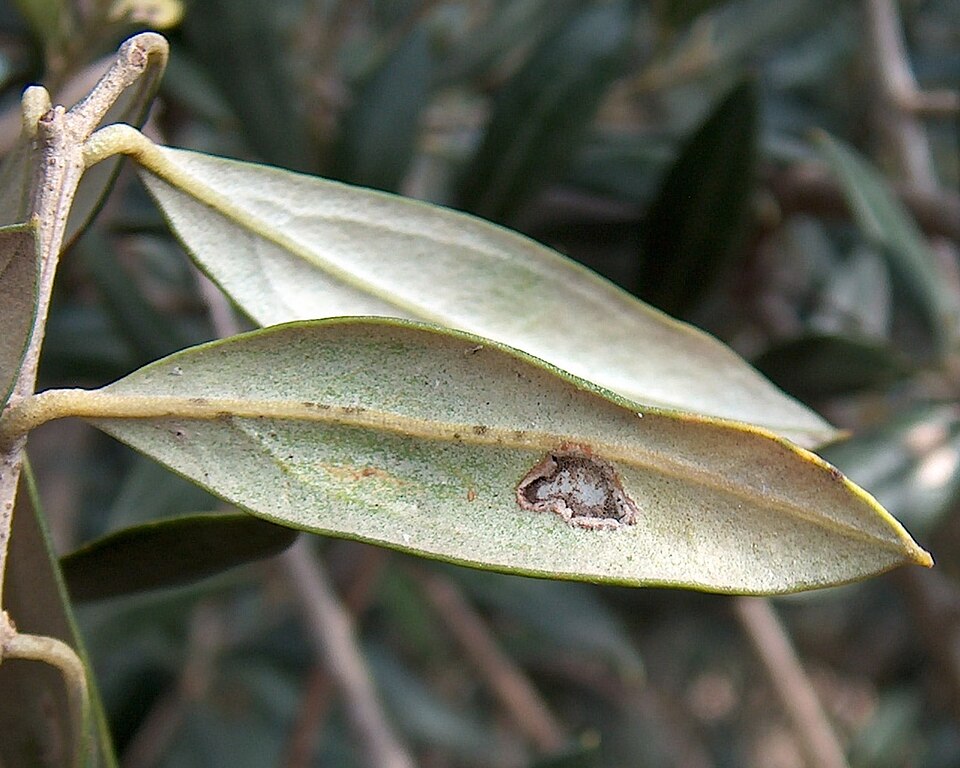
Leaf damage caused by an olive moth larva. Photo: Giancarlo Dessì / Wikimedia Commons · resized for this page · CC BY-SA 3.0. - Saissetia oleae — black scale. This sap-feeding insect excretes sticky honeydew on which sooty mould can grow. Heavy infestations can weaken trees and reduce productivity. Parasitoid wasps are among its natural enemies. UC IPM black scale guide.
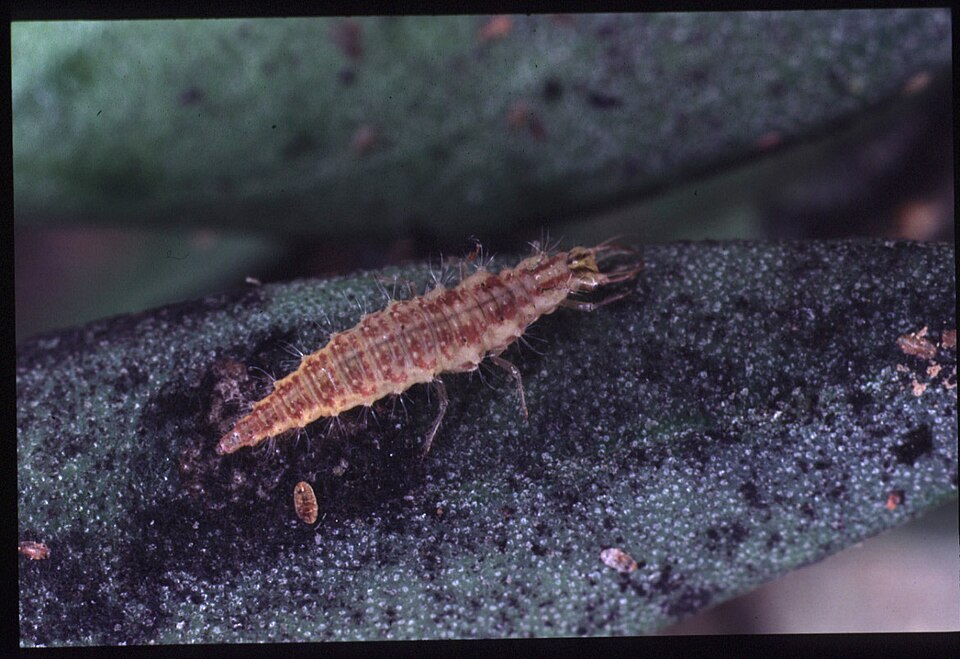
A predatory lacewing larva feeding on black scale on an olive leaf. Photo: Christian Pinatel de Salvator / Wikimedia Commons · resized for this page · CC BY 3.0. - Euphyllura olivina — olive psyllid. Nymphs and adults suck sap from shoots, buds and flower clusters. Large colonies can leave waxy secretions and honeydew and contribute to flower drop. University of California, Riverside profile.
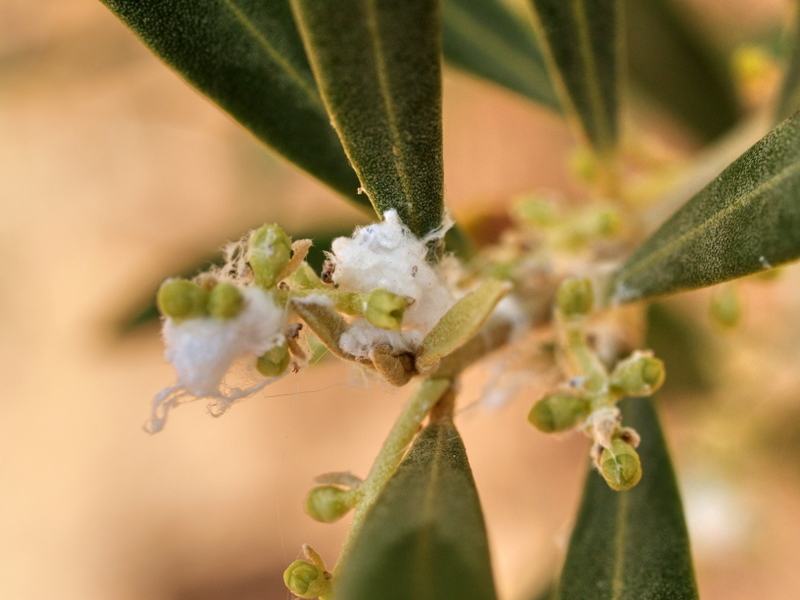
Waxy secretions from olive psyllid nymphs on olive flowers. Photo: Morini33 / Wikimedia Commons · CC BY 3.0. - Psyttalia concolor — parasitoid wasp of the olive fruit fly. The wasp lays eggs in fly larvae; its own larva develops inside the host and eventually kills it. It is studied as a biological-control ally, though results vary. Scientific study.
- Meloidogyne spp. — root-knot nematodes. These microscopic nematodes parasitize roots. A survey in southern Spain found them in 6.6% of sampled olive plants; rates can vary by location and conditions. Study of cultivated and wild olive (English).


Diseases of olive trees
The diseases below are examples reported in olive-growing regions. The photographs show examples of symptoms, not diagnostic tests. Leaf scorch, leaf loss and branch dieback can have different causes, so symptoms alone do not identify a pathogen. For suspected Xylella fastidiosa, follow the current official plant-health guidance.
- Olive quick decline syndrome (OQDS). This syndrome is associated with the bacterium Xylella fastidiosa, which blocks water-conducting xylem vessels. It may cause wilting, scorch at leaf tips and edges, branch dieback and progressive decline. These signs are not specific to Xylella. The bacterium has been detected in Portugal; consult DGAV for current demarcated areas and guidance. DGAV: Xylella information and demarcated areas · EFSA overview.
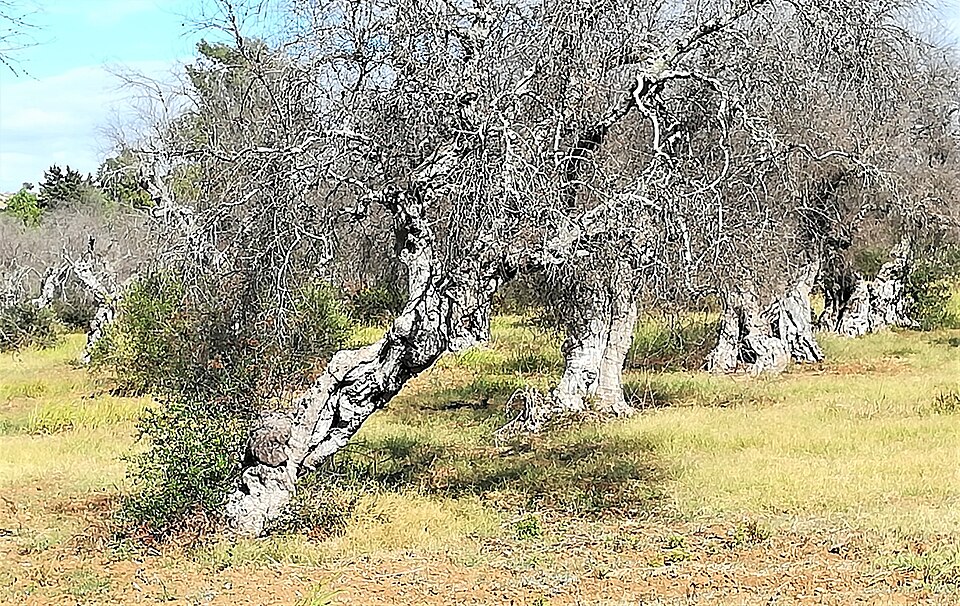
Olive trees reported as affected by Xylella near Gallipoli, Italy (2019). Photo: G.steph.rocket / Wikimedia Commons · public domain; resized for this page. - Peacock spot (olive leaf spot). This fungal disease is caused by Venturia oleaginea (also known as Spilocaea oleagina). It produces round, dark leaf spots, often with concentric rings and a yellow halo; severe infections can cause premature leaf fall. Pacific Northwest Plant Disease Management Handbook.
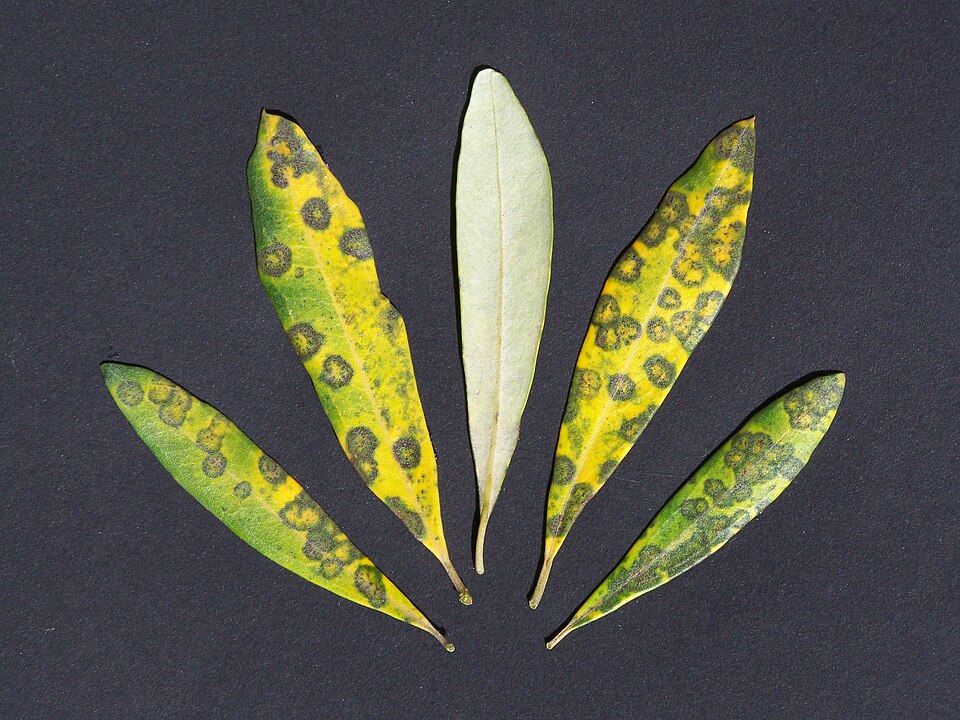
Olive leaves with peacock spot. Photo: Eric Coffinet / Wikimedia Commons · public domain; resized for this page. - Olive knot. The bacterium Pseudomonas savastanoi pv. savastanoi causes rough galls on twigs and branches, often at wounds or leaf nodes. Galls can girdle shoots and contribute to dieback. UC IPM olive knot guide.
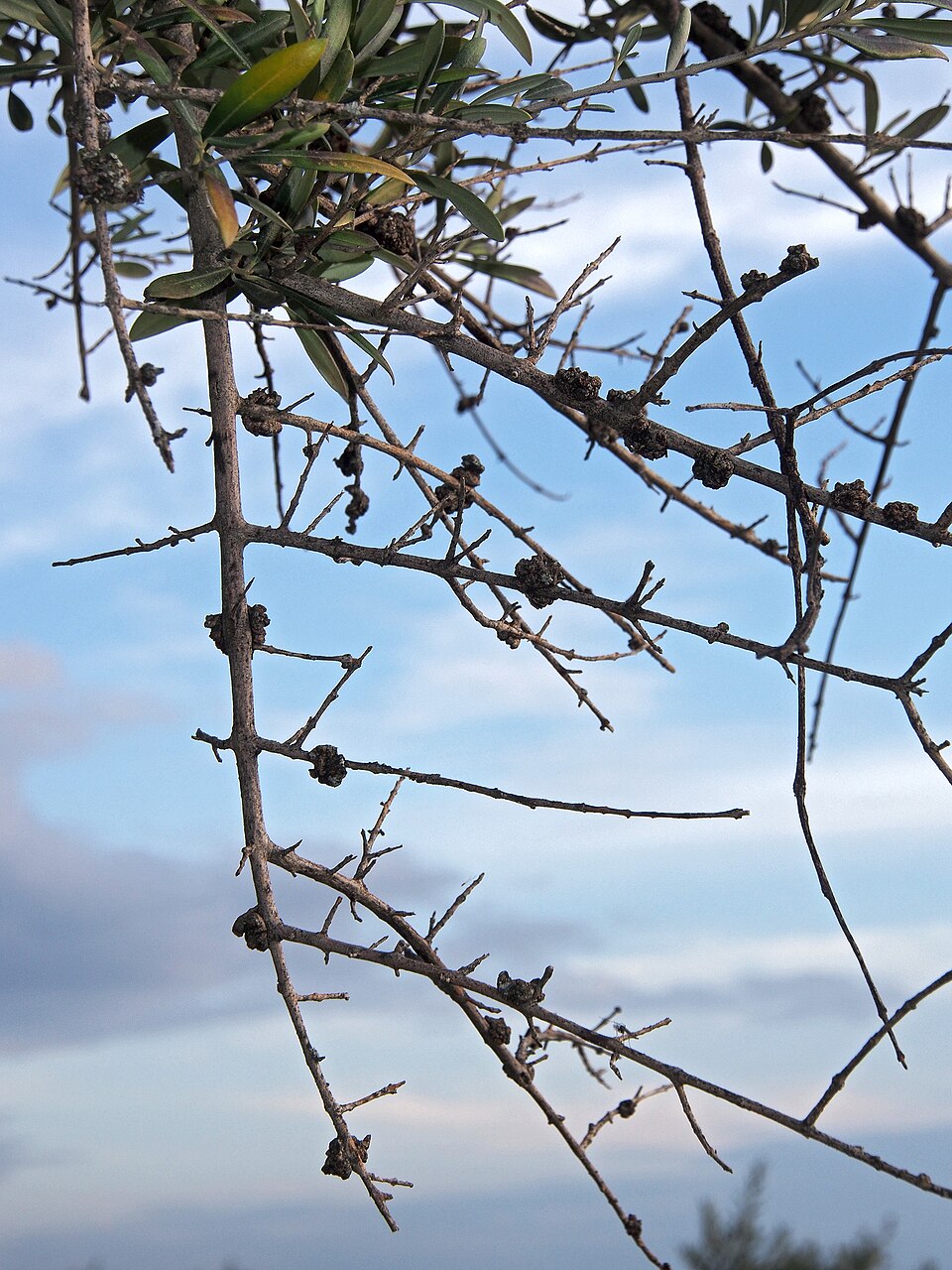
Olive branches with galls attributed to Pseudomonas savastanoi, photographed in Spain. Photo: Luis Fernández García / Wikimedia Commons · resized for this page · CC BY-SA 4.0. - Anthracnose (olive fruit rot). Fungi in the genus Colletotrichum infect the fruit, causing sunken lesions and rot; affected olives may fall or shrivel on the tree. The disease can reduce yield and oil quality. Scientific review of olive anthracnose.
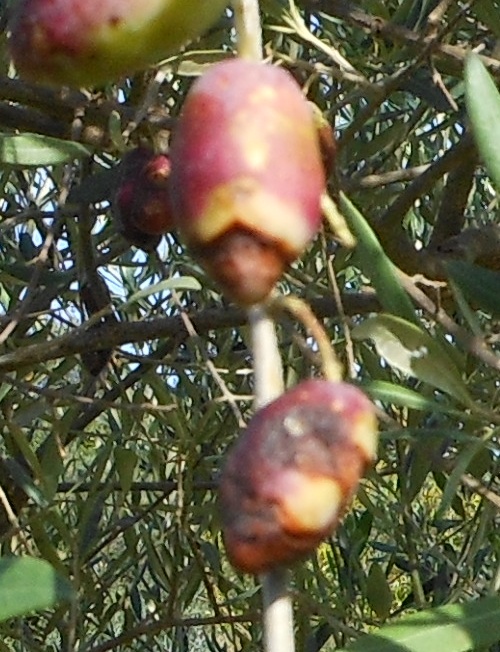
Picholine olives with damage attributed to Colletotrichum. Photo: Raymond Gimilio / Wikimedia Commons · CC BY-SA 4.0.


