The olive tree / Botany
The olive tree
The botanical characteristics of Olea europaea
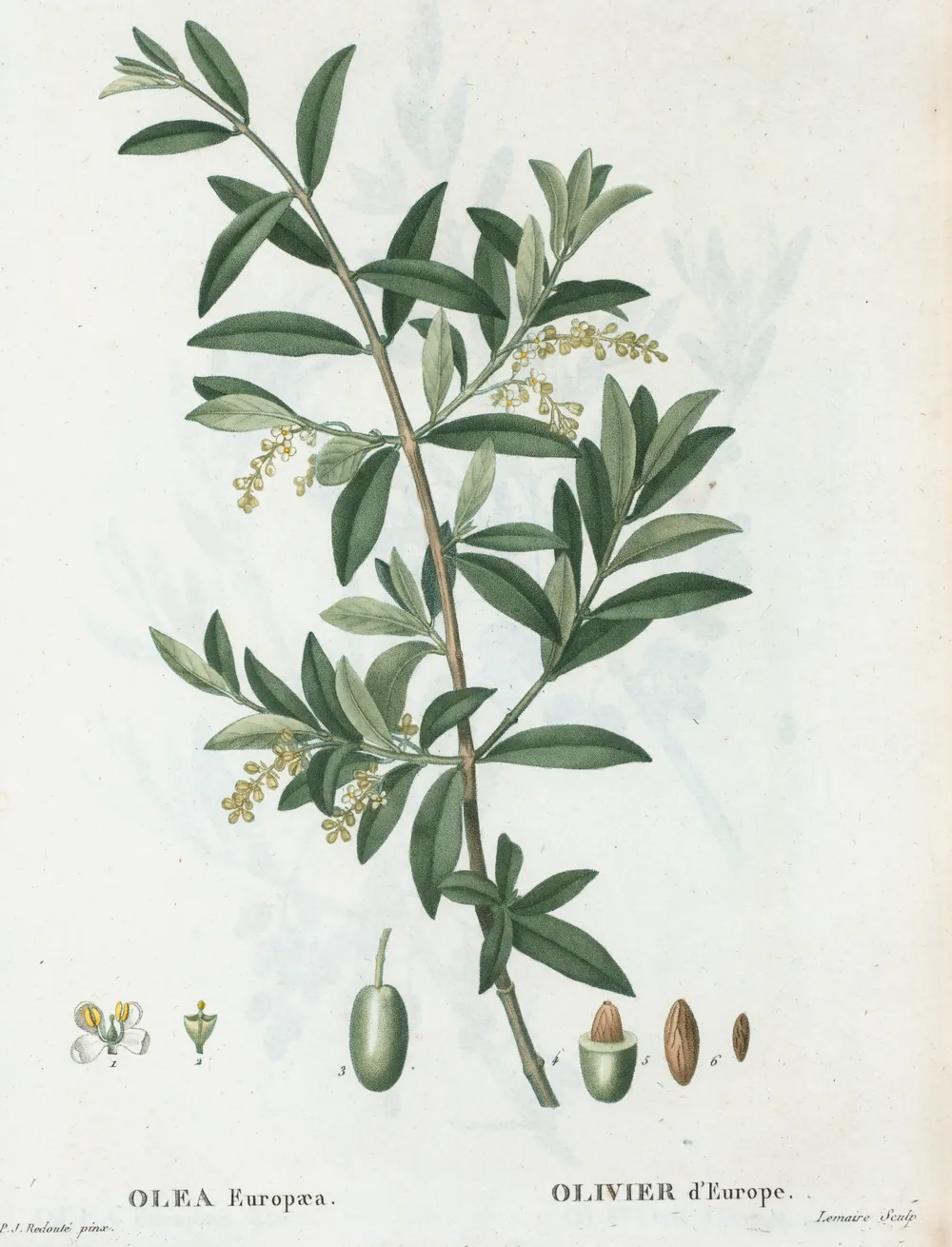
The olive tree belongs to the Oleaceae family. It is an evergreen flowering tree: rather than losing all its leaves in autumn, it keeps a leafy crown throughout the year. The cultivated olive combines slow woody growth with an annual cycle of flowering and fruit development.
Leaves: green above, silver below
The leaves are simple, meaning each has a single, undivided blade. They grow in opposite pairs along the shoots and are usually narrow and lance-shaped, sometimes more elliptical. Their texture is firm and leathery.
The upper surface is grey-green; the underside looks silvery because it is covered with fine hairs. Together with the tough leaf surface, this covering helps the tree cope with bright sun and dry conditions.
Trunk, bark and growth
An olive tree grows slowly and naturally forms a rounded crown. Young bark is relatively smooth and grey. With age, the trunk becomes thicker, furrowed and often twisted. Pruning also shapes the crown and the arrangement of its branches.
A trunk’s appearance is not a reliable measure of its age. Growing conditions, pruning and damage can all influence its form.
Flowers and pollination
Small, cream-white flowers develop in branched clusters called panicles, arising where leaves meet the shoots. Flowering occurs in spring or early summer, depending on the climate and cultivar.
The tree can bear both flowers with male and female organs and flowers that function only as male flowers. Pollen is carried mainly by the wind. Fruit set can improve when compatible cultivars flower at the same time; not every flower becomes an olive.
The olive: a stone fruit
Botanically, an olive is a drupe. Beneath its skin lies a fleshy layer, the mesocarp, surrounding a hard stone, the endocarp, which encloses the seed. The flesh is the main source of the oil extracted at the mill.
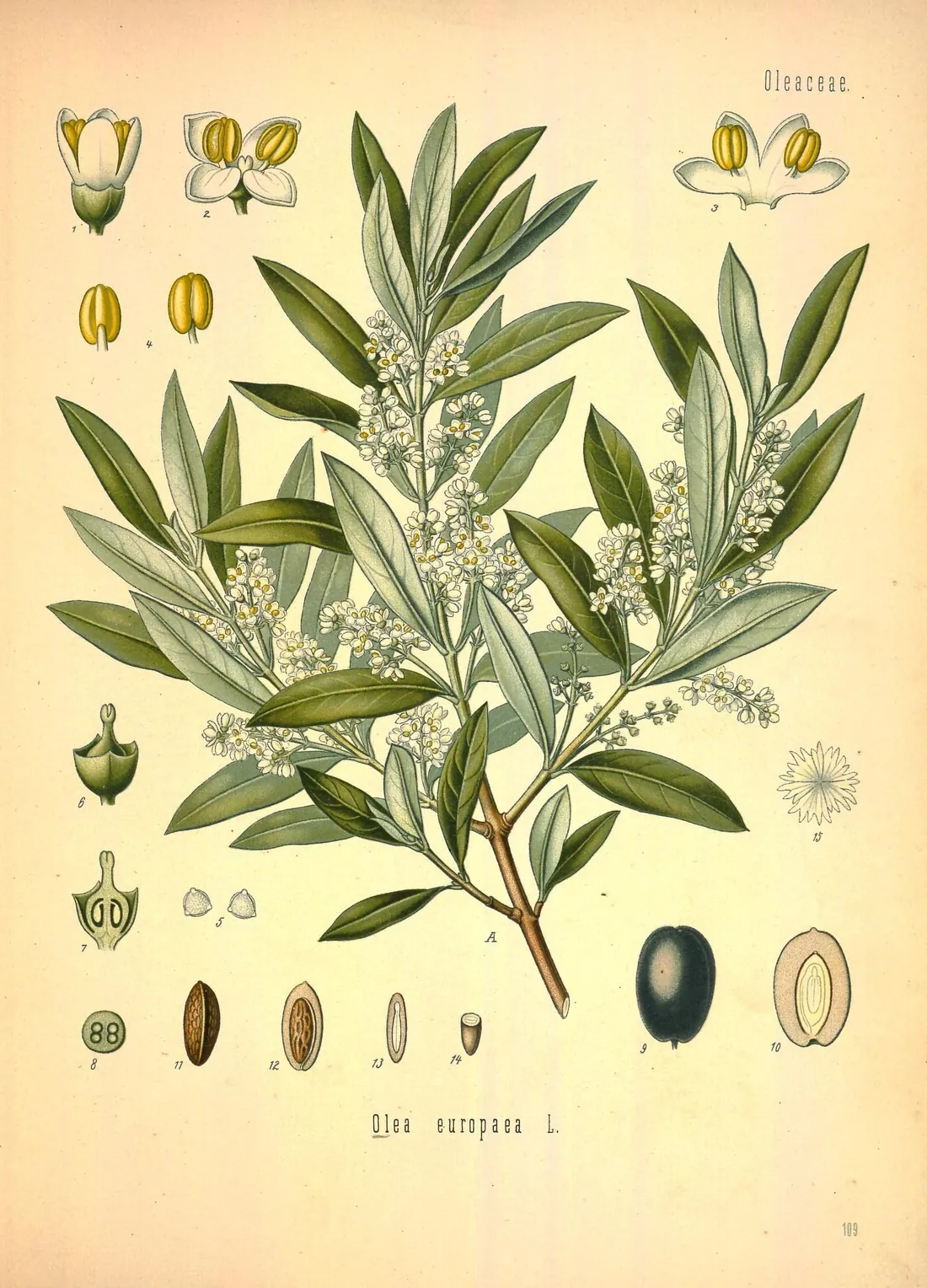
Olives start green and develop darker purple or black tones as they ripen. Their size, shape and rate of ripening vary with the cultivar and growing conditions. Green and dark olives are different stages of ripeness, not necessarily different varieties.
A tree adapted to Mediterranean conditions
Olive trees favour sunny sites and well-drained soil, with mild winters and hot, dry summers. Established trees tolerate drought, but water availability still influences growth, flowering and fruit development. Prolonged waterlogging is unsuitable for their roots.
Flowering is followed by fruit growth through the warmer months and ripening towards autumn and winter. The timing varies from place to place and from one season to the next.
A Mediterranean origin — still being studied
Wild olives (oleasters) and cultivated trees share a long Mediterranean history. One genetic and phylogeographic study proposes the northern Levant as the main centre of initial domestication, and identifies other ancient wild-olive refugia in the eastern Mediterranean, the Aegean and near the Strait of Gibraltar. This is not a single, undisputed origin: later genomic analyses found repeated crosses between wild and cultivated olives during domestication.
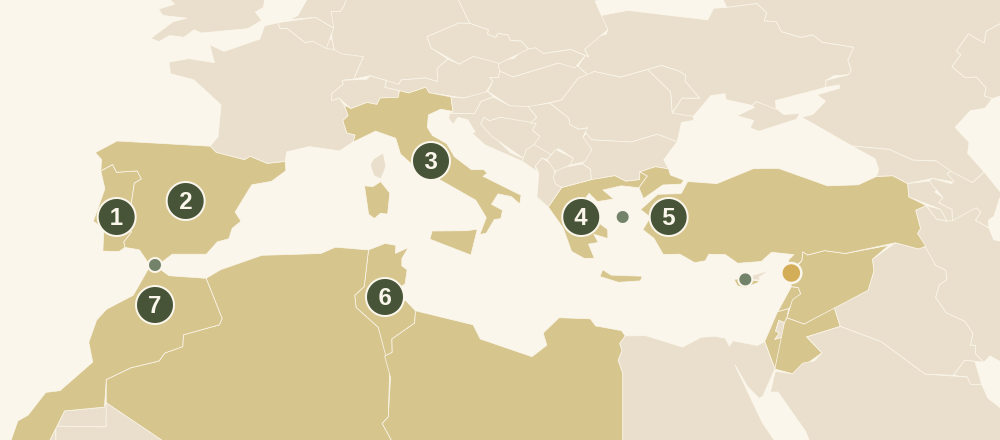
Proposed initial-domestication areaAncient wild-olive refugiaCultivars — countries of origin
Research: Lineage diversification and the northern Levant domestication hypothesis · Genomic evidence of admixture during domestication.
One species, many cultivars
Over centuries, growers selected and propagated olive trees with distinct characteristics. The list below brings together the 60 cultivars currently shown in the International Olive Council (IOC) World Catalogue; each name links to its catalogue profile. The IOC list is a documented reference, not necessarily an inventory of every local name and synonym in use.
- Aggezi ShamiEgypt
- AmfissisGreece
- AraucoArgentina
- ArbequinaSpain
- ArbosanaSpain
- BaladiLebanon
- BarneaIsrael
- BeladiLebanon
- BugaSlovenia
- CaroleaItaly
- ChalkidikisGreece
- Chemlal de KabilyeAlgeria
- Chemlali SfaxTunisia
- ChetouiTunisia
- CobrançosaPortugal
- CoratinaItaly
- Cordovıl de SerpaPortugal
- CornicabraSpain
- CrnicaMontenegro
- DomatTürkiye
- FrantoioItaly
- Galega VulgarPortugal
- GemlikTürkiye
- Gordal SevillanaSpain
- HaouziaMorocco
- HojiblancaSpain
- Istarska BjelicaSlovenia
- KalamonGreece
- KalinjotAlbania
- Kato DrysCyprus
- KoroneikiGreece
- LadoeliaCyprus
- LastovkaCroatia
- LeccinoItaly
- Manzanilla CacereñaSpain
- Manzanilla de SevillaSpain
- MariIran
- MaurinoItaly
- MemecikTürkiye
- MenaraMorocco
- MeskiTunisia
- MixaniAlbania
- Nabali BaladiJordan
- Nocellara del BelıceItaly
- OblicaCroatia
- OueslatiTunisia
- PeranzanaItaly
- Picholine du LanguedocFrance
- Picholine MarocaineMorocco
- PicualSpain
- RowghaniIran
- SalonenqueFrance
- SigoiseAlgeria
- SouriIsrael
- Soury or SoraniLebanon
- ToffahiEgypt
- TsounatiGreece
- UsluTürkiye
- ZardIran
- ZuticaMontenegro
Source and detailed profiles: World Catalogue of Olive Varieties — International Olive Council. Profiles are in English.
Portuguese cultivars outside the IOC catalogue
The IOC catalogue does not include every traditional Portuguese cultivar. Portugal’s register lists Lentrisca (an official synonym of Lentisca) and distinguishes three Verdeal cultivars — Alentejana, de Elvas and Transmontana — that do not appear in its table.
- Lentrisca (Lentisca)Portugal
- Verdeal AlentejanaPortugal
- Verdeal de ElvasPortugal
- Verdeal TransmontanaPortugal
Sources: National Register of Fruit Varieties 2025, pp. 21–23 (DGAV, in Portuguese) · Verdeal Alentejana study (INIAV, in Portuguese) · Verdeal Transmontana study (Scientia Horticulturae, 2015) · Lentisca in Azeites do Ribatejo PDO (PTPT, in Portuguese) · Verdeal Transmontana in Azeite de Trás-os-Montes PDO (PTPT, in Portuguese).
Portuguese National Register (DGAV): 65 cultivars
The 2025 National Register of Fruit Varieties lists 65 traditional olive cultivars. This list gives the registered names and synonyms specified in the register’s notes; it is not intended to cover every local name in use. Each entry links to the official register or, where available, a variety-specific profile.
- AzeitoneiraSynonyms: Azeiteira, Negrinha, Carrasca Comprida, Manzanilla Cacereña (ES)
- Bical de Castelo BrancoSynonym: Conserva das Barrancas
- Bico de Corvo
- Blanqueta de ElvasSynonyms: Branquita, Villalonga (ES)
- BorrentaSynonyms: Borraceira, Borreira
- Carrasca
- Carrasca Molar
- Carraspana
- Carrasquenha Azuladinha
- Carrasquenha de ElvasSynonyms: Carrasquenha, Carrasquenha de Campo Maior
- Carrasquenha TradicionalSynonym: Vermelhal
- Carrasquenho Miúdo
- Carrasquinha
- CérolaSynonym: Cérole (ES)
- CobrançosaSynonyms: Quebrançosa, Salgueira
- Conserva de Elvas
- Coração de Lebre
- Cordovesa
- Cordovil Branco
- Cordovil de Castelo Branco
- Cordovil de ElvasSynonym: Curtideira
- Cordovil de SerpaSynonym: Cordovil de Moura
- Cordovil de Trás-os-MontesSynonym: Bical
- Cordovil Grosso
- Cordovil Macho
- Cordovil Moscatel
- Cornalhuda
- CornicabraAlso registered in Portugal
- Enxerta
- Feijões de GaloSynonym: Colhanitos de Galo
- GalegaSynonyms: Galega Vulgar, Galega Meuda, Molar, Negrucha, Coimbreira
- Galega Grada de Serpa
- Galego Bical
- Galego de ÉvoraSynonyms: Bical de Évora, Bicuda, Galego de Borba
- Galego Grosso
- GamaSynonym: Gamenha
- Grainheira
- Gulosinha
- Judiaga
- LentiscaSynonyms: Lentrisca, Lentrisqueira
- LeucocarpaSynonym: Branca
- LinguiçeiraSynonym: Passareira
- Longal
- Longar
- Maçanilha AlgarviaSynonym: Maçanilha de Tavira
- Maçanilha de Elvas
- MaduralSynonyms: Cercial, Comum
- Moral
- Negrinha de Freixo
- Negrita
- Negroa
- Ocal
- Orelha de Mula
- Planalto
- Quinta do Portado
- Redondal
- RedondilSynonym: Manzanilla (ES)
- SantulhanaSynonyms: Regalona, Cruzada
- Tentilheira
- Verde Verdelho
- Verdeal AlentejanaSynonyms: Verdeal de Serpa, Verdeal
- Verdeal de Elvas
- Verdeal TransmontanaSynonym: Verdeal de Trás-os-Montes
- Zambulha
- Zimbreiro
Official source: National Register of Fruit Varieties 2025 — DGAV, pp. 21–23. Specific profiles: Bical de Castelo Branco · Cordovil de Castelo Branco · Galega Vulgar.
From the Mediterranean to the world
Commercial cultivation is still concentrated around the Mediterranean basin, but it has also taken root in other suitable regions. This map highlights, as examples, growing areas in California, Chile and Argentina, South Africa and Australia. The dots are illustrative, not exhaustive or precise agricultural boundaries.
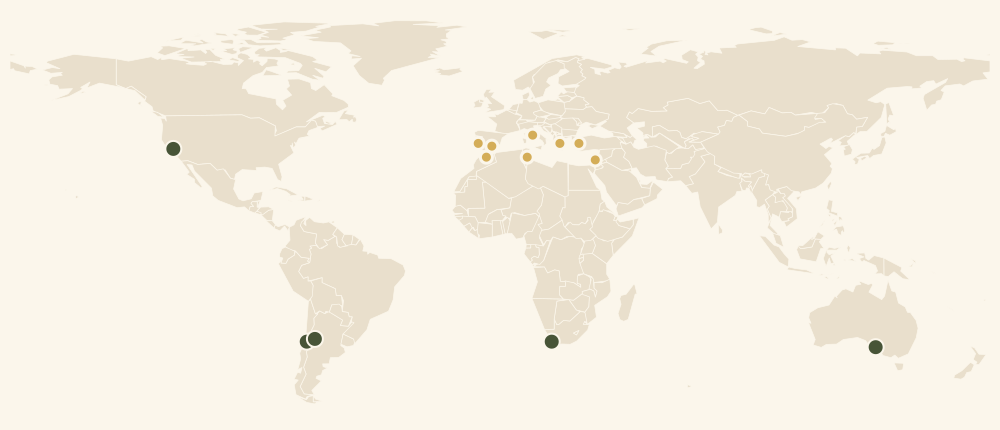
Mediterranean — main growing regionOther regions shown: California, Chile, Argentina, South Africa and Australia
Sources: Olive sector statistics — International Olive Council · Olive cultivation in the southern hemisphere: flowering, water and oil quality · University of California, Davis Olive Center grower resources.
A newcomer to the world, ancient in Europe
The olive tree has spread around the world, but outside the Mediterranean basin it is a newcomer. In South America, the first cultivated olive trees only arrived around 1560, in Peru, brought from Seville.
Even if they had been planted by Christopher Columbus (1492), Vasco da Gama (1498) or Pedro Álvares Cabral (1500) with their own hands, the oldest olive trees in those new lands would be only a little over 500 years old today.
In Mediterranean Europe, the scale is entirely different. The Oliveira do Mouchão, in Mouriscas (Abrantes), Portugal, has an estimated age of about 3,350 years — more than six times the maximum age of any olive tree planted in the Age of Discovery. The centuries-old and millennia-old trees of traditional groves are a heritage no recent grove can reproduce.
This comparison concerns the cultivated olive of the Mediterranean basin; other wild subspecies of Olea europaea are native to parts of Africa and Asia.
Sources: The olive tree in the Americas (Idesia, SciELO Chile, in Spanish) · Oliveira do Mouchão (Portuguese Tree of the Year, in Portuguese).
See the local cultivar names and tree notes at Olival da Azenha.
Botanical references: NC State Extension — Olea europaea · FAO Ecocrop — olive · From flower to fruit: olive fruit growth and development.